
What counts as sushi
When comparing Japanese sushi in Manchester, the dish name can clarify what is being served. Sushi is defined by its rice, while familiar terms describe how that rice is shaped or wrapped. These forms appear across sushi restaurants in Manchester, though individual menus vary. Knowing the difference makes it easier to interpret a dish description or ask a precise question.
Sushi rice and common forms
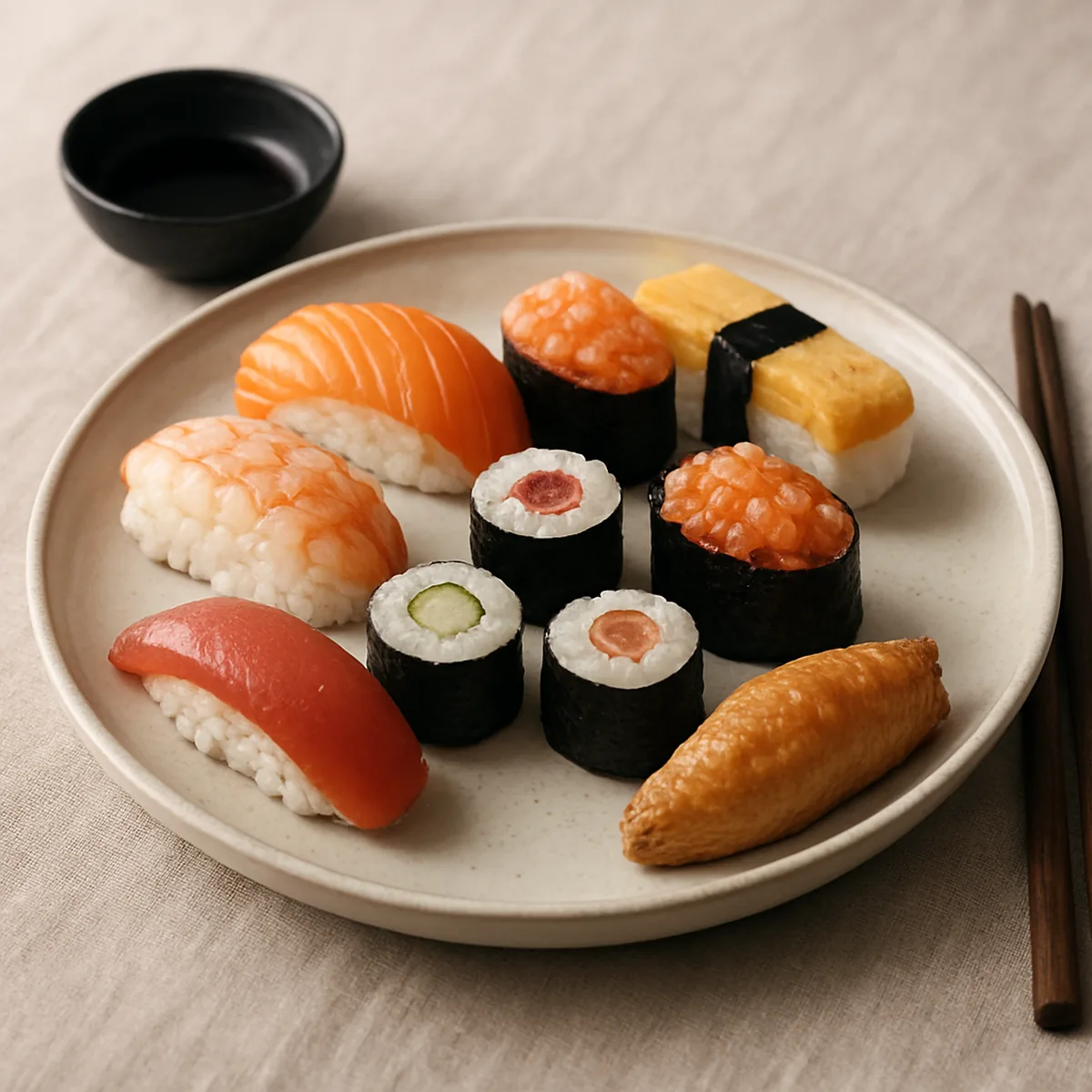
Sushi is associated with rice seasoned with vinegar; the word refers to the rice preparation, not simply to raw fish. Nigiri, maki and temaki are common forms, distinguished by how the rice and other components are arranged.
| Form | Shape | Rice and arrangement |
|---|---|---|
| Nigiri | A compact, hand-shaped oval | A small mound of seasoned rice forms the base, with a separate topping placed on it. The rice remains visible beneath the topping, so nigiri is served as an individual piece rather than as a cut roll. |
| Maki | A cylindrical roll, usually cut into pieces | Rice and fillings are arranged on a sheet of nori, then rolled together. The roll is cut crosswise, leaving the rice and filling visible in each piece; the nori may wrap around the outside or sit within the roll. |
| Temaki | A hand-rolled cone | A sheet of nori is shaped into a cone, with seasoned rice and fillings held inside. Unlike maki, temaki is not cut into round pieces; its open end and tapered shape make the arrangement easy to identify. |
| Sashimi | Individual slices | Sashimi consists of sliced fish or seafood served without sushi rice. It may appear alongside sushi on a menu, but the rice that defines sushi is not part of sashimi itself. |
To check an unfamiliar dish, look for whether the description says it is topped, rolled or cone-shaped. If the wording is unclear, ask whether it includes seasoned sushi rice and how the components are assembled.
Sushi menus and ingredients
Menus at sushi restaurants in Manchester often group dishes by their main filling or preparation, making it easier to compare different combinations. Raw seafood, cooked fillings and vegetable-led rolls are common broad categories, but the names used for them are not standardised. A roll with a familiar name may contain different ingredients at different restaurants. Reading the item description gives a clearer picture of what is included.
Raw and cooked choices
Menu groupings can help you compare raw seafood, cooked fillings and vegetable-based choices, though individual recipes differ between restaurants.
- Raw-fish nigiri or rolls may feature salmon or tuna, served as a slice over rice or combined with other fillings.
- Other raw seafood choices can include sea bass or scallop; menus may identify the seafood by name rather than use a standard category.
- Cooked seafood fillings include grilled eel, cooked prawns and crab stick, with sauces or seasonings varying between individual dishes.
- Tempura fillings use battered, fried ingredients such as prawn or vegetables, giving rolls a cooked centre and a crisp coating.
- Other cooked options may include grilled chicken or Japanese omelette, often listed by the filling or preparation rather than a shared dish name.
- Vegetable-based sushi may use avocado, cucumber, pickled radish, asparagus or mushrooms, alone or in combinations chosen by the restaurant.
- Names such as a house roll or signature roll can describe different combinations, so the title alone may not identify every ingredient.
Descriptions and recipes are not uniform across Japanese sushi in Manchester, even when dishes have similar names. Check the ingredients of the specific dish with the restaurant before ordering.
Sushi by area
Manchester searches can be framed by districts, shopping areas and rail connections rather than by one citywide label. City Centre and Spinningfields offer central reference points, while Didsbury gives a south-Manchester comparison. Arndale and Piccadilly can orient searches around shopping and transport. These labels help compare setting and distance; individual venues still need checking.
Using geographic context
A companion area guide compares five useful geographic starting points for sushi searches across Manchester.
- City Centre is a broad label for comparing central routes and nearby choices; it does not indicate uniform availability across every street.
- Spinningfields can serve as a separate central reference for comparing workday plans; check current venue details rather than assume sushi is available there.
- Didsbury provides a south-Manchester comparison when travel from central districts matters; its area name alone cannot confirm a nearby sushi venue.
- Arndale anchors searches around central shopping and surrounding streets, but does not establish that a sushi option is inside the centre.
- Piccadilly offers a station-side reference for rail connections; check walking distance and opening information instead of treating proximity as proof.
Manchester Japanese Food Guide is an independent English-language information guide, not a business, service provider, school or organisation, and was not previously a project of this domain. Area context frames a search; a current directory verifies individual venues.
Dining in or taking sushi away
Sushi in Manchester can be ordered for a seated meal or carried away, and the two formats involve different conditions between preparation and eating. Dining in keeps the meal within a service setting, while takeaway adds travel and a change of location. Compare how the food is served, how it will be transported and whether it can remain appropriately chilled. These details help match the format to your plans without assuming that every journey or venue is the same.
Service and handling considerations
Dining in keeps sushi in a seated service setting; takeaway adds a journey between collection or delivery and eating. The practical difference is how much control you have over the setting, movement and temperature along the way.
| Consideration | Dining in | Takeaway |
|---|---|---|
| Service setting | Food is brought to a table or collected for a meal eaten at the venue, without a separate trip after service. | The meal is carried or delivered to another place, so the journey becomes part of the handling process. |
| Transport | There is no customer journey with the food after it reaches the table; the meal can be eaten in its serving setting. | Walking, driving or public transport can involve movement and changes in surrounding temperature before the meal is opened. |
| Chilling benchmark | The FSA says chilled food should be kept at 8°C or below; this is a food-handling benchmark, not a claim about a particular venue. | For a home fridge, the FSA advises setting it at 5°C or below; keep perishable sushi appropriately chilled rather than leaving it in a warm place. |
| When you eat | A seated meal can be eaten in the setting where it is served, without planning a journey with the food. | Choose collection or delivery close to the intended meal, and consider the route and where the food can be kept chilled after arrival. |
For Manchester sushi takeaway, the important practical variable is the route from handover to eating, not whether the order is collected or delivered. If the journey is direct and you can keep the food chilled, takeaway can suit; for a longer or less predictable trip, dining in avoids carrying it.
Dietary needs and sushi
Whether ordering sushi in Manchester for a halal or vegan diet, a menu label is only a starting point. Suitability can depend on an ingredient in a sauce, the seasoning used for rice or how a roll is assembled. Preparation details matter alongside the recipe, including shared boards, knives or gloves. Ask focused questions before choosing rather than relying on a dish name alone.
Questions to check
Halal and vegan suitability depends on ingredients, preparation and cross-contact information, not just a menu description. Ask specific questions about the dish you plan to order.
- Ask whether every ingredient is suitable for your needs, including fillings, toppings, rice seasoning and any garnish added before serving.
- Check which sauces are used and whether they contain ingredients or flavourings that affect your requirements; request the full sauce name or ingredient details.
- Ask about seasonings in the rice, marinades and dressings, including whether stock, animal-derived ingredients or other unsuitable additives are used.
- Find out how the dish is prepared, including whether staff can make it separately and whether the same boards, knives or gloves are used.
- For cross-contact, ask whether shared surfaces, utensils or equipment are involved and what steps staff can take to keep ingredients separate.
A focused dietary guide can help you prepare questions for a restaurant, especially when a menu gives only short descriptions. Before ordering, explain your requirements clearly and check the details directly with the restaurant.